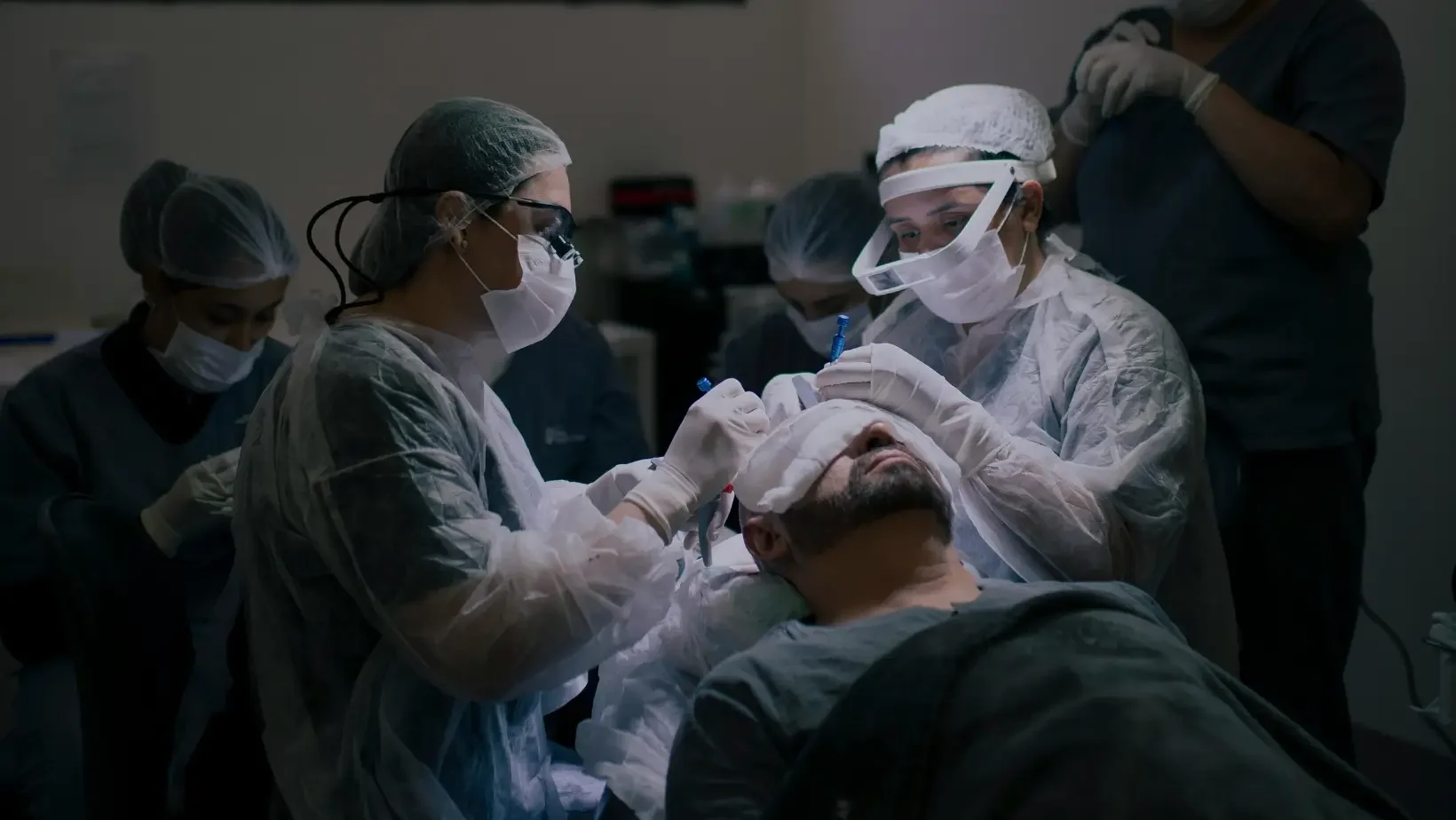
FUE vs. FUT Hair Transplants: Which is Better?
If you are researching a hair transplant, the FUE vs FUT debate will come up in your first hour of searching. Most clinic websites push FUE as the modern, minimally invasive option and imply FUT is old fashioned. The truth is more useful, and less flattering to the industry.
At Hair Repair Clinic we work with Dr Ahmad Moussa, a UK trained hair transplant surgeon who has performed both FUE and FUT for over a decade. This guide is the honest comparison we wish more UK clinics would publish: what each method actually does, when each is the right choice, what marketing gets wrong, and how to protect yourself from the technician-led shortcuts that have taken over the low cost end of the industry.
What FUE is: Follicular Unit Extraction
FUE removes hair follicles one at a time from the donor area at the back and sides of the scalp using a small circular punch (typically 0.8mm to 1mm diameter). Each individual follicular unit (a natural cluster of 1 to 4 hairs) is extracted with a tiny round wound, harvested, then transplanted into the recipient area on the top and front of the scalp.
- Scar profile: hundreds of tiny circular dots across the donor area rather than one linear scar. When healed, these are hard to spot even at a shaved zero grade if the extraction was done cleanly.
- Recovery: the small punch wounds heal in 7 to 10 days. Physical activity can usually resume in 2 weeks. The recipient area scabs and settles over 10 to 14 days.
- Session size: typically 2,000 to 3,500 grafts per day. Larger cases are usually split over two consecutive days.
- Session duration: 6 to 10 hours depending on graft count.
- Graft transection risk: higher than FUT if performed by untrained hands. This is the key clinical question, covered below.
What FUT is: Follicular Unit Transplantation
FUT (also called the strip method) takes a thin horizontal strip of skin, typically 1cm to 1.5cm wide, from the back of the scalp under the safe donor zone. A trained team dissects that strip under microscopes into individual follicular units (again, 1 to 4 hairs per unit), which are then transplanted into the recipient area exactly as with FUE.
- Scar profile: one linear scar across the back of the scalp, hidden under existing hair when kept at grade 3 or longer. Under a very short crop (grade 1 or 2) the scar can show as a fine line.
- Recovery: stitches or staples are removed at 10 to 14 days. Physical activity is limited for 3 to 4 weeks to protect the donor closure.
- Session size: can comfortably reach 3,500 to 4,500+ grafts in a single day, higher than typical FUE cases.
- Session duration: 5 to 8 hours.
- Graft transection risk: lower than FUE, because microscope dissection gives clear visibility of each follicular unit before separation.
The transection rate: what actually matters
Graft transection is the number of hair follicles damaged or cut during extraction. It is the single most important quality metric in a hair transplant, and the one nobody advertising cheap FUE talks about.
A damaged follicle does not grow. If a clinic advertises 3,000 grafts but transects 20% during extraction, you have paid for 3,000 grafts and received 2,400 viable ones. The result is thinner density than expected, sometimes visibly patchy, sometimes not obvious until a year post op when the growth cycle finishes.
- Published transection rates for FUT: 2% to 5% with an experienced team using microscope dissection. This is the benchmark all other methods are compared against.
- Published transection rates for FUE by experienced surgeons: 3% to 8%. Comparable to FUT in the right hands.
- Transection rates in high volume FUE clinics using technicians only: published surveys and independent audits have documented rates of 15% to 30% at some overseas mega clinics. This is why patients occasionally return from cheap Turkey packages with disappointing growth despite the graft count that was quoted.
The surgeon or technician performing the extraction matters more than the FUE vs FUT choice. A skilled FUT surgeon will produce a better hair transplant than an inexperienced FUE clinic even at twice the price. This is the point Dr Ahmad Moussa makes repeatedly to prospective patients.
FUT is UK surgeon regulated. FUE is not.
This is a UK regulatory point that changes how you should evaluate a clinic:
- FUT requires a qualified surgeon in the UK. Because it involves excising skin (a surgical procedure by any medical definition), FUT can only be performed by a doctor with current medical registration. In practice this means a General Medical Council registered doctor, ideally with membership of the Royal College of Surgeons.
- FUE, technically, does not require a doctor. Because the individual punch extraction is arguably a minor procedure, many UK clinics offering FUE only rely on technicians with minimal or no direct surgeon involvement. A doctor may sign off the case at consultation but not personally perform the extraction.
- What this means for you: if a UK clinic offers both FUE and FUT, they have a qualified surgeon on staff. If they only offer FUE, ask directly who will be performing your surgery. If it is a technician, ask what training that person has and who supervises them.
Dr Ahmad Moussa's approach at Hair Repair Clinic
Dr Ahmad Moussa is a UK trained hair transplant surgeon with experience in both FUE and FUT going back over a decade. He performs the extraction and implantation stages personally, not delegated to a technician, and specialises in cases where graft survival and long term appearance matter more than a bulk session count.
His view: FUE and FUT are both good techniques when done by someone who understands what they are doing. Both are bad when done badly. The right method for a given patient depends on hair type, donor availability, target graft count, recovery preferences, and scar acceptance. There is no universal winner.
When FUE is the right choice
- You keep your hair very short (grade 1 or 2 or bald) and cannot afford any risk of a visible linear scar.
- Your donor area is not tight, meaning it will tolerate multiple sessions in future without closure difficulty.
- The graft count you need is under 3,000 in one session, easily achievable in a single day of FUE.
- You cannot take 3 weeks off physical activity for donor healing after FUT.
- Beard or body hair extraction is required (only feasible via FUE).
- You are having a small session for hairline refinement or a specific area, where FUE flexibility is an advantage.
When FUT is the right choice
- You have Afro textured hair. The curl of Afro hair follicles below the scalp surface makes FUE punch extraction technically harder, and transection rates rise. FUT under microscope dissection is much safer for curly hair types.
- You need a large graft count (3,500 or more) and want to avoid two consecutive full day sessions.
- You want the lowest possible transection rate and are willing to accept a linear scar in exchange for higher graft survival.
- You keep your hair at grade 3 or longer and are comfortable with a fine linear scar that will be hidden under regular length hair.
- Your donor area is limited and you want to preserve as much of the future donor supply as possible (strip closes and leaves the surrounding density intact, whereas FUE thins the donor visibly as the punch density rises).
- You are having a large restoration for an advanced Norwood pattern and want to maximise the yield from the safe donor area.
Cost: UK versus overseas
In the UK, a properly surgeon-led FUE typically prices between £5,000 and £10,000 depending on graft count and clinic. FUT with a UK surgeon prices similarly, sometimes slightly lower per graft because a larger session can be completed in one day.
The same graft count in Turkey or India can be quoted at £2,000 to £3,000, sometimes including flights and hotel. The apparent saving is real. What is often left out of the marketing:
- The extraction is likely to be performed by a technician team, not a surgeon.
- Transection rates are difficult to audit independently in overseas clinics.
- Aftercare in the UK falls back on the NHS or your own GP if something goes wrong. The transplant clinic is often not reachable for follow up questions after you fly home.
- A poor outcome from an overseas clinic is very expensive to fix. Repair transplants performed by UK surgeons typically cost more than a well done original would have.
The right question is not "which is cheaper" but "what is the true cost including the risk of a failed transplant that needs to be redone in the UK." For many people the honest answer is that a UK clinic with a surgeon performing the extraction is better value even at twice the sticker price.
Recovery timeline for each method
FUE recovery week by week:
- Days 1 to 3: some tenderness in the donor and recipient areas. Scalp is not bandaged. Sleep with head elevated.
- Days 4 to 7: transplanted area scabs form and then start to shed as they heal.
- Days 7 to 10: small circular donor punches close and heal. Wear a loose fitting hat if you are self conscious.
- Weeks 2 to 4: transplanted hairs enter the shedding (shock loss) phase. This is normal and expected. The follicles are alive under the scalp.
- Weeks 4 to 12: quiet phase. The follicles are resting before new growth begins.
- Months 3 to 6: first visible regrowth. Density builds week on week.
- Months 6 to 12: full regrowth is judged at 12 months post op. Some final density gains through month 15.
FUT recovery week by week:
- Days 1 to 3: donor closure feels tight. Recipient scabs form. Sleep with head elevated.
- Days 10 to 14: stitches or staples removed. The linear scar is fully closed but pink for another 2 to 3 months as it matures.
- Weeks 2 to 4: avoid strenuous exercise to protect the donor closure. Transplanted hairs enter shock loss.
- Weeks 4 to 12: follicles rest. The linear scar continues to fade.
- Months 3 to 6: first visible regrowth.
- Months 6 to 12: full result. The scar has usually faded to a fine line that a grade 3 or longer haircut fully hides.
Questions to ask before booking any hair transplant
- Who will personally perform my extraction (not who signs off the case), and what are their qualifications and years of experience?
- What is your published transection rate, and how do you audit it?
- How many grafts have you personally performed in the last 12 months?
- What percentage of your cases are FUE vs FUT? A clinic that only offers one is a red flag: they are picking the method to their skill set, not yours.
- What is the aftercare plan, and how do I reach you at 2 months post op if I have a concern?
- Can I see photographs of your own results at 12 months post op, not stock photos or before shots only?
- If my result is disappointing at 12 months, what is your policy on remedial work?
Any UK clinic that answers all seven questions clearly is worth talking to. A clinic that dodges questions 1, 2 or 3 is a clinic to walk away from.
Who should NOT have a hair transplant
- Anyone under 25 with a genetic history of aggressive hair loss who has not yet stabilised on medical treatment (finasteride or dutasteride plus minoxidil). Doing a transplant before medical treatment locks in the current pattern is a fast route to a transplant that looks strange as the surrounding hair continues to recede.
- Anyone with an unrealistic expectation of density or hairline. A hair transplant redistributes existing donor hair. It does not create new hair. The right expectation is significant improvement, not a full restoration to a 20 year old hairline.
- Anyone with active scalp infection, uncontrolled diabetes, immune suppression or bleeding disorders. These require medical clearance before any transplant can proceed.
Before booking a hair transplant, get on medical treatment first. Our finasteride 1mg, dutasteride 0.5mg, and topical minoxidil in TrichoSol® options stabilise the surrounding hair before you invest in a transplant. Medical treatment plus transplant is a much better combination than transplant alone.
Book a call with Dr Ahmad Moussa
The right method for you depends on your hair pattern, donor area, target density, hair type and recovery preferences. A 20 minute call with our team is the best way to work out what you actually need before you commit to any procedure or clinic.
Book a free call with Hair Repair Clinic. No pressure to book a procedure; the call is to answer your questions and give you an honest read on whether FUE, FUT, medical treatment, or a combination is the right next step.
Medical reviewer: Dr Ahmad Moussa MB BCh, MSc, MRCS(Eng), MD, FRCS(SN), NHS Neurosurgeon and Hair Transplant Surgeon.
Published: . Last updated: . Last reviewed: . All prescription medications are dispensed by a GPhC registered UK partner pharmacy.
Disclaimer: this page is for general information only and does not constitute medical advice. Prescription treatments are not appropriate for everyone. Prescription only treatment is supplied only where a UK registered prescriber judges it clinically appropriate after reviewing your online medical questionnaire.
Related Articles
4 Signs That You Are Losing Your Hair
15 Jun 2026

PRP Therapy- Thicken your hair and prevent ongoing hair loss
9 May 2026
Proven Hair Loss Treatments
7 Feb 2025

Should You Use Ketoconazole Shampoo for Hair Loss?
5 Jun 2024
The Norwood Reaper and The Big 3
10 Jan 2024

Topical Finasteride: How to Choose the Right Strength for Your Hair Loss
1 Dec 2023