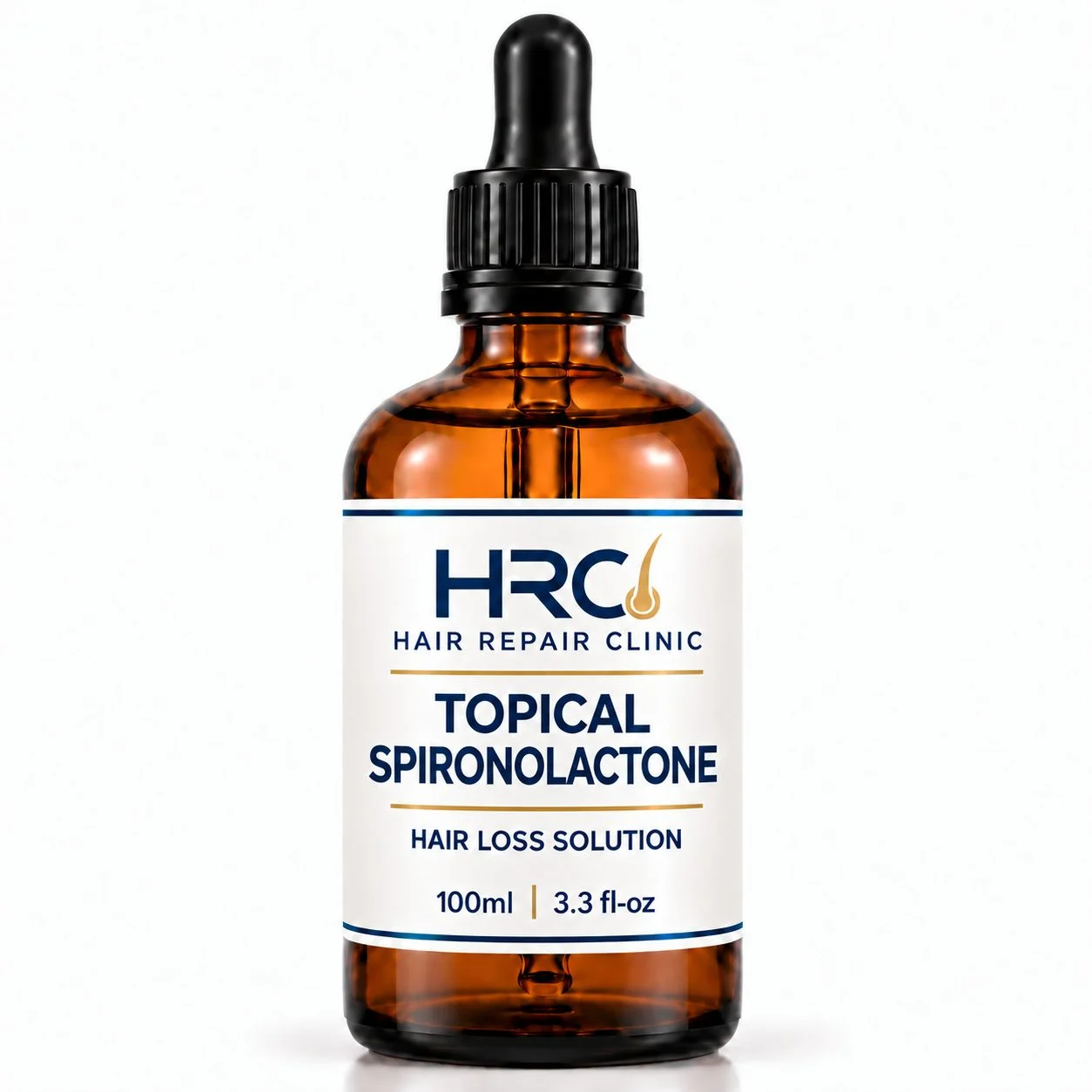

Topical Spironolactone in TrichoSol: Hair Loss Treatment 100ml
Topical spironolactone is a prescription 2% solution for hair loss. Suitable for men and women. Apply once daily.
Spironolactone
Sulphur smell: spironolactone contains sulphur, so it has a distinctive smell which some people find unpleasant. Orders are non refundable as these are custom compounded for every individual order.
Base
Spironolactone
Prices are shown below. You can choose a strength once you have completed the medical questionnaire.
Add Minoxidil? (optional)
Add Tretinoin? (optional)
£0.00
✓ Prescription Included
✓ Delivery Included
Description
Topical Spironolactone 2% in TrichoSol (100ml)
Prescription topical spironolactone 2% compounded in the TrichoSol base by Fagron. Spironolactone is an anti-androgen: it blocks androgen receptors in the scalp, reducing DHT's ability to shrink hair follicles. Topical application delivers the anti-androgen effect locally, with lower systemic absorption than oral spironolactone. From £70 per 100ml bottle (roughly three months of nightly use).
100ml UK supply, made fresh in the UK
Every bottle is compounded fresh in the UK by a GPhC registered partner pharmacy in the TrichoSol base from Fagron. The formula is prepared to order at the strength your prescriber approves, so you get a fresh 100ml bottle (roughly three months of nightly use at 1ml per day) rather than a mass-produced solution sitting on a shelf.
How topical spironolactone works for hair loss
Spironolactone is an aldosterone antagonist that also blocks androgen receptors. When DHT binds to androgen receptors in the scalp, it triggers follicle miniaturisation (the mechanism behind pattern hair loss). Spironolactone occupies those receptors instead, so DHT cannot send its miniaturising signal.
This is different from finasteride and dutasteride, which reduce DHT production upstream. Spironolactone allows DHT to be made but blocks its action at the receptor. Both approaches lower the effective DHT signal at the follicle; they just do it at different stages.
Applied topically at 2%, spironolactone delivers its effect locally with minimal systemic absorption. Blood levels are far lower than with oral spironolactone, so the hormonal side effects (breast tenderness, menstrual changes, increased urination) that limit oral use are much less common.
Who this is for
Women with female pattern hair loss: the primary intended audience. Spironolactone is a standard treatment for hormonally driven female hair loss.
Anyone who cannot tolerate oral spironolactone: the topical route sidesteps most of the hormonal side effects that limit oral use.
Anyone avoiding oral finasteride or dutasteride: for women concerned about oral DHT blockers or for whom they are not suitable, topical spironolactone offers a different mechanism at the receptor level.
Men with pattern hair loss: less commonly used but possible, particularly for men who cannot tolerate finasteride's sexual side effects.
Why the TrichoSol base matters
Standard alcohol-and-glycol vehicles used in off-the-shelf topical solutions cause itching, redness and contact dermatitis in a meaningful proportion of women. The TrichoSol base from Fagron is propylene glycol free and low alcohol, so it is much better tolerated on sensitive scalps. Note the 2% spironolactone formulation does contain some ethanol for solubility, so is slightly drier than a pure TrichoSol base.
How to apply
Apply 1ml to affected areas of the scalp once daily, ideally in the evening after washing.
Part the hair and apply directly to the scalp, not the hair itself.
Massage in gently with clean fingertips.
Do not rinse. Leave to dry naturally.
Wash hands after application.
Consistency matters more than perfection. Missing days slows progress, particularly in the first few months.
What to expect
2 to 3 months: reduced shedding is often the first sign.
3 to 6 months: visible thickening and regrowth is judged if it is going to happen.
12 months: full effect. Results are maintained with continued nightly use.
On stopping: hair gained is gradually lost over several months as DHT signalling at the follicle returns to baseline.
Every bottle has a distinctive sulphur smell on application. This is normal for spironolactone, which contains sulphur, and some people find it unpleasant.
Side effects
Topical spironolactone reaches the bloodstream far less than the oral tablet, so the hormonal side effects that limit oral use are much less likely. When effects do occur they are usually local to the scalp, and it is well tolerated by the majority of women who use it for female pattern hair loss.
Exact frequencies are not established for compounded topical spironolactone, and the rates quoted for the oral tablet do not carry across, so the list below is ordered by likelihood rather than precise figures.
More likely (local, at the application site)
Mild scalp irritation, itching or dryness. The ethanol in the 2% solution can add to the dryness.
Less likely
Contact dermatitis at the application site.
Mild breast tenderness (uncommon at topical doses).
Unlikely (mostly associated with the oral tablet)
Menstrual irregularity.
Increased urination.
Raised potassium. Low risk topically, but more relevant if you also take oral spironolactone or a potassium-sparing medicine.
When to seek urgent medical advice
Signs of an allergic reaction: facial or lip swelling, difficulty breathing, rash.
Symptoms of high potassium: muscle weakness, palpitations, unusual fatigue (very rare with topical use, more relevant to oral spironolactone).
Who should not use topical spironolactone
Not suitable during pregnancy or breastfeeding. Spironolactone in any form can affect a male foetus. Discuss contraception with your prescriber before starting if you are of childbearing age.
Known allergy to spironolactone.
Do not apply to broken skin or an inflamed scalp; wait for the scalp to heal first.
Anyone with high blood potassium or on potassium-sparing medications should have this reviewed with the prescriber first (very low risk at topical doses, but flagged for completeness).
Under 18.
Warnings and precautions
Pregnancy: Not suitable during pregnancy or breastfeeding, because spironolactone can affect a male foetus. Discuss contraception with your prescriber before starting if you are of childbearing age.
Sulphur smell: spironolactone contains sulphur, so it has a distinctive smell which some people find unpleasant.
Ethanol content: the 2% formulation contains ethanol for solubility, which may cause more scalp dryness than a pure TrichoSol base.
Combining with oral spironolactone: rarely needed and increases the risk of hormonal side effects. Discuss with your prescriber.
Combining topical spironolactone with other hair loss treatments
This is a compounded bottle, so you can add other actives to the same 100ml formula in the configurator rather than buying a second product.
Add minoxidil to the bottle (2% to 15%, prescriber approved) for growth stimulation on top of the anti androgen effect. Spironolactone plus minoxidil is the standard female pattern regimen. Available as an add on when you configure your bottle.
Add tretinoin to the bottle (0.01% or 0.025%) if you know you are a slow minoxidil responder. Available as an add on when you configure your bottle.
Want melatonin, a proper DHT blocker or other actives (finasteride or dutasteride, melatonin, niacinamide and more)? See our Custom Topical Solution for the wider active palette. One 100ml bottle, one prescriber review.
Prescription included
Complete the short online health questionnaire at checkout. A UK prescriber reviews your answers; most approvals are the same day. Your bottle is compounded fresh in the UK by a GPhC registered partner pharmacy and includes delivery.
Frequently asked questions
How do I apply this treatment?+
Apply it directly to the scalp in the areas being treated rather than coating the hair, then wash your hands and let the scalp dry fully. Your dispensing label sets how much to use and how often, and it takes priority over any general guidance. Our full guide covers application, storage and what to expect.
What is topical spironolactone and who is it for?+
This is a topical spironolactone 2% solution primarily used for female pattern hair loss. Spironolactone is an anti-androgen: it blocks androgen receptors in the scalp, so DHT cannot trigger follicle miniaturisation. Applied topically, it delivers this effect locally with minimal systemic absorption.
Is topical spironolactone safe for women?+
Yes. Topical spironolactone has minimal systemic absorption compared with oral spironolactone, so most of the hormonal side effects (breast tenderness, menstrual changes, increased urination) that limit oral use are much less common. It is well tolerated by the majority of women.
Can men use topical spironolactone?+
Yes. Topical spironolactone can be used by men, particularly those who cannot tolerate finasteride or want to avoid oral DHT blockers. It is more commonly prescribed for female hair loss but there is no reason it cannot be used for male pattern loss under prescriber guidance.
How long does topical spironolactone take to work?+
Reduced shedding at 2 to 3 months, visible thickening and regrowth at 3 to 6 months of consistent nightly use. Full effect at 12 months.
How do I apply topical spironolactone?+
Apply 1ml to the affected areas of the scalp once daily, usually in the evening after washing. Massage in gently and do not rinse off. Wash hands after application.
Is topical spironolactone safe during pregnancy or breastfeeding?+
No. Spironolactone in any form is not suitable during pregnancy or breastfeeding because it can affect a male foetus. Discuss contraception with your prescriber before starting if you are of childbearing age.
Does topical spironolactone have a sulphur smell?+
Yes. Spironolactone contains sulphur, so it has a distinctive smell when applied, which some people find unpleasant.
Can I use topical spironolactone with topical minoxidil?+
Yes. Minoxidil can be added directly to your spironolactone bottle in the configurator, so you do not need a second product. Spironolactone plus minoxidil is one of the most effective non-oral regimens for female pattern hair loss: spironolactone blocks the androgen signal, minoxidil stimulates growth.
Can I combine topical spironolactone with topical melatonin?+
Yes. Spironolactone plus melatonin is a common female pattern combination: spironolactone blocks androgen receptors (anti DHT effect), melatonin provides antioxidant follicle support. The tidiest way to run both is to use our Custom Topical Solution and add melatonin to your spironolactone plus minoxidil bottle, so it is one 100ml formula rather than two.
How much does topical spironolactone cost in the UK?+
Topical spironolactone starts from £70 for a 100ml bottle, roughly three months of nightly use at 1ml per day. UK prescriber review and UK delivery are included.
Can I return this item?+
Prescription and custom-compounded medicines cannot be returned once dispensed under UK pharmacy regulations. Non-prescription items may be returned within 14 days if unused and in their original packaging. See our returns policy at hairrepairclinic.co.uk/returns-policy for full details.
Disclaimer: this page is for general information only and does not constitute medical advice. Prescription treatments are not appropriate for everyone. Prescription only treatment is supplied only where a UK registered prescriber judges it clinically appropriate after reviewing your online medical questionnaire.
Last updated: